
Bear James Park trail extension paused! A note from organizer Michele Roy
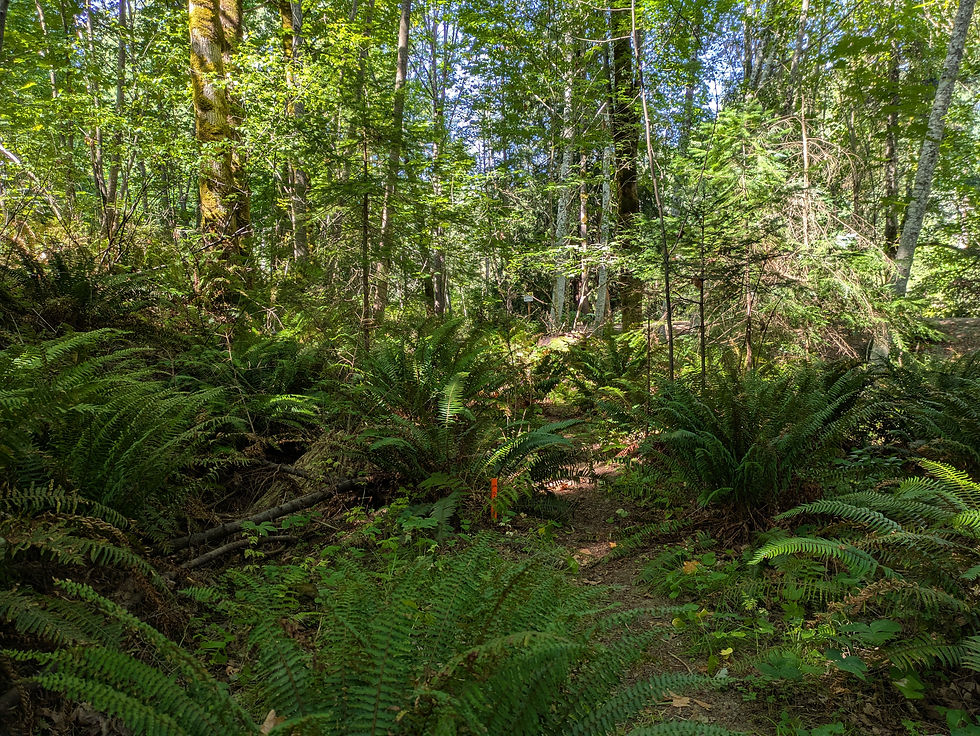

We live in a fabulous community, full of people who care deeply about the natural spaces that dot our community and the streams, rivers, and creeks that feed them.
That caring was demonstrated over and over again during the past few weeks, when our community became aware of the City of Courtenay Parks Department’s plan to build a new “path” through our treasured Bear James Park. The proposed 95-metre-long by 3-metre-wide “path” was intended to function as a road for City and contractor service vehicles to access the park for trail repairs, channel upgrades, and bridge replacement.
What was unknown to most of us was that a road into the park already exists through our local River Heights Church. For decades, this road has provided vehicle access for the City, its contractors, BC Hydro, DFO, Search and Rescue, and the Fire Department to reach the same area that this new path would serve.
The church had not been approached by the City for the use of its road for park access for a couple of decades. When the church manager/owner learned that the City was planning to build a new path through the park rather than continue using the existing church road, he immediately wrote to the City and offered authorization for them to use the road.
The community responded with action. Doors were knocked on, neighbours were connected, petitions were signed, messages were shared, people were invited to listen, and understanding was built.
A gathering in the park was held where information was shared—as much as we had, given that the City did not reach out to inform the public about the project until it felt compelled to do so after a petition with more than 200 names was sent to the Mayor and Council. People also shared their experiences of living near, walking and being in this treasured park.
Stories reminded everyone at the gathering of how much the peaceful environment of Bear James Park has meant to our community over the years: walking its trails with children and grandchildren, watching salmon spawn in the channel each fall, and observing Coho salmon grow through a year of rearing in the channel before heading out to the open ocean.
Adding trails to an intact riparian area in such a small park would have severely and negatively impacted this unique habitat, where owls, mink, otters and deer make their homes, and which maintains the health of the stream where pink, chum and coho salmon live and spawn.
Over the past two weeks, my husband and I have spoken with many stakeholders throughout this process, including the City Parks Department, River Heights Church, contractors, and environmental organizations. In every conversation, I listened to their varied and diverse interests: operational efficiency, budgets, descriptions of machinery and its requirements, the plants needed for restoration, and how restoration would be carried out.
Yet we also know that restoration is expensive to maintain and is rarely maintained over the long term, which can result in further degradation of riparian areas. Walk through our local parks and you can see how streams and creeks are affected by foot and dog traffic, which slowly erodes the riparian areas and impacts the streams next to them.
We asked the City to delay the project and begin conversations with River Heights Church about using its existing road. This would eliminate the need to build another pathway for service vehicles and, importantly, allow this intact riparian area to remain a natural, undisturbed space. We also asked the City to adhere to their own Official Community Plan (OCP) which clearly states in several policies to protect the natural environment and sensitive ecosystems, and to collaborate with landowners and community organizations to conserve and restore these areas.
For now, the City has paused the project.
But the larger issue remains.
The community was not consulted at any time during this process. In our conversations, the official stakeholders appeared focused primarily on their own mandates, interests, operational needs, and existing relationships. There was very little acknowledgement of, or attention given to, the community that would be directly affected by the proposed work.
That is why our protest—and our determination to be heard—is so important. It must never be dismissed.
This experience has taught me that when the people who live in and care for a place are not consulted, and when their concerns are ignored by those with decision-making power, we must speak up and use every peaceful and democratic means available to us.
Restoring and strengthening democracy is of vital importance. It is our responsibility to make this message heard during the upcoming municipal elections in our city.
Our community has shown what can happen when people care enough to become involved. We have neighbours who care deeply about our parks, our waterways, our wildlife, and the natural spaces that make this such a wonderful place to live.
Bear James Park belongs not only to the institutions that manage it, but to the community that knows it, walks it, loves it, and is committed to protecting it.
Our voices matter. Our participation matters. And when decisions affecting our shared natural spaces are being made, the community must have a meaningful place at the table.


Comments